
New analysis of six independent studies covering 680 million citations, 2,961 research sessions, and 1.96 million browsing sessions finds AI search converts at 5.1x the rate of Google organic — but 78% of marketers have no strategy for AI visibility.
SEATTLE, April 3, 2026 /PRNewswire/ — Loganix, a performance SEO and link building services provider, today released findings from its 2026 B2B AI Buying Behavior Analysis — a multi-source synthesis examining how business buyers use AI search tools during the purchase research process and what that means for brand visibility strategy.
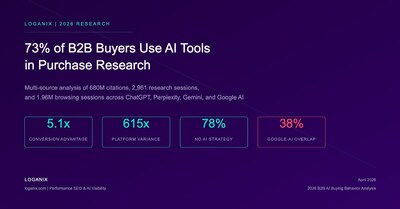
The analysis combined data from six independently published studies conducted between October 2025 and March 2026, covering a combined dataset of 680 million AI citations, 2,961 controlled research sessions, and 1.96 million browsing sessions across ChatGPT, Perplexity, Gemini, and Google AI Overviews.
The headline finding: 73% of B2B buyers now use AI tools like ChatGPT and Perplexity in their research process, according to a March 2026 analysis of 680 million citations by Averi. AI search traffic converts at 14.2% compared to Google organic’s 2.8% — a 5.1x advantage — yet only 22% of marketers currently track AI visibility and fewer than 26% plan to develop content specifically for AI citations.
Key Findings
B2B AI Search Adoption Has Reached Critical Mass
B2B buyer behavior shifted measurably between 2024 and 2026. McKinsey’s October 2025 consumer survey found approximately 50% of consumers across all demographics — including boomers — intentionally use AI-powered search for purchasing decisions. Averi’s March 2026 analysis of 680 million citations across ChatGPT, Claude, and Google AI confirmed the B2B figure has reached 73%.
Similarweb’s 2026 AI Brand Visibility Report found 35% of consumers use AI tools at the discovery and initial ideas stage of research, compared to 13.6% using traditional search at the same stage. For B2B purchases specifically, Forrester’s 2025 survey of 4,000+ buyers found 61% of the buying journey completes before the buyer contacts a vendor — a figure that increases when AI tools provide synthesized comparisons that previously required multiple site visits.
AI Search Traffic Converts at 5.1x the Rate of Traditional Organic
AI search traffic converts at 14.2% compared to Google organic’s 2.8%, according to Exposure Ninja’s March 2026 analysis. The conversion advantage varies by platform: Claude users convert at 16.8%, ChatGPT at 14.2%, and Perplexity at 12.4%. SE Ranking’s independent study found AI visitors spend 68% more time on websites than traditional organic visitors. The Washington Post reported AI platform visitors have a 4-5x higher subscription conversion rate versus traditional search, according to Karl Wells, the publication’s Chief Revenue Officer.
Table 1: AI search conversion rate by platform
| Platform | Conversion Rate | Multiplier vs Google Organic |
| Claude | 16.8 % | 6.0x |
| ChatGPT | 14.2 % | 5.1x |
| Perplexity | 12.4 % | 4.4x |
| Google Organic (baseline) | 2.8 % | 1.0x |
Source: Exposure Ninja, March 2026. Platform-specific rates: Fahlout synthesis of multiple sources.
AI Platforms Cite Dramatically Different Sources for the Same Query
AI search is not a single channel. Citation volumes for the same brand can differ by 615x between platforms, according to Superlines’ March 2026 cross-platform analysis. Only 11% of domains are cited by both ChatGPT and Perplexity, per Averi’s 680 million citation study. Passionfruit’s analysis of 15,000 queries found only 12% of cited sources match across ChatGPT, Perplexity, and Google AI.
The divergence extends to source types. ChatGPT leans on listings for 48.7% of local source citations, while Gemini favors websites at 52.1%. Perplexity diversifies across review platforms and community sources. Reddit accounts for 46.7% of top Perplexity citations but under 10% on ChatGPT following a September 2025 rebalancing. A brand visible on one platform may be entirely absent from another.
Table 2: Cross-platform citation divergence
| Metric | Finding | Source |
| Cross-platform citation variance | Up to 615x between platforms for same brand | Superlines, Mar 2026 |
| Domain overlap (ChatGPT vs Perplexity) | 11% of domains cited by both | Averi, 680M citations |
| Source match across 3 platforms | 12% of cited sources shared | Passionfruit, 15K queries |
| Google #1 rank to ChatGPT citation overlap | 6.5% URL overlap | Shashko / Bright Data, 42K citations |
Sources as cited. Compiled by Loganix, April 2026.
Most Marketers Are Not Tracking or Targeting AI Visibility
Despite 73% buyer adoption, marketing teams have not adjusted. Only 22% of marketers currently track AI visibility and traffic. Only 25.7% plan to develop content specifically for AI citations. 64% are unsure how to measure AI search success, according to Yext’s 2025 companion report surveying 2,237 adults.
The gap between buyer behavior and marketer response represents a window. 72% of marketing leaders expect AI to surpass SEO as the primary visibility channel within three years, but fewer than one in four have implemented any measurement. Brands that establish AI visibility infrastructure now operate in a market where most competitors have not begun.
Brand Mentions Correlate 3x More Strongly with AI Citation Than Backlinks
Brand web mentions show a Spearman correlation of 0.664 with AI citation rates — approximately three times stronger than the backlink correlation of 0.218, according to an analysis of 75,000 brands by Ahrefs. A separate study from The Digital Bloom analyzing 680 million citations confirmed the same direction. Brand search volume correlates at 0.334 with AI citation — moderate, but substantially weaker than the mention signal.
The implication for B2B marketers is that the signals driving AI visibility differ from those driving traditional search rankings. Link building remains important for search engine rankings that feed AI retrieval systems, but the strongest single predictor of whether a brand appears in AI answers is how frequently that brand is mentioned across authoritative web sources — regardless of whether those mentions include a hyperlink.
Methodology
The Loganix 2026 B2B AI Buying Behavior Analysis synthesized findings from six independently published studies: Averi (680 million citations, March 2026), SparkToro and Gumshoe.ai (2,961 research sessions across 600 volunteers, January 2026), Previsible (1.96 million browsing sessions, November 2024 through November 2025), Exposure Ninja (conversion rate analysis, March 2026), McKinsey (consumer survey, October 2025), and Yext (2,237 adults, March through April 2025). Platform-specific conversion rates were compiled from a Fahlout synthesis of multiple independent sources. All statistics are attributed to their original published source. Loganix did not conduct primary data collection for this analysis.
Frequently Asked Questions
How do B2B buyers use AI tools during purchase research?
B2B buyers use AI search tools to generate shortlists, compare vendors, evaluate pricing, and synthesize reviews — tasks that previously required visiting multiple websites. Averi’s 680 million citation analysis found 73% of B2B buyers now incorporate AI tools into their research process. Forrester’s survey of 4,000+ buyers found 61% of the purchase journey completes before any vendor contact, a figure AI tools accelerate by providing consolidated comparisons within a single interface.
Why does AI search traffic convert better than organic search?
AI search traffic converts at higher rates because visitors arriving from AI platforms are pre-qualified through the AI’s synthesis process. The AI has already filtered options, compared alternatives, and presented a curated recommendation before the user clicks through to the brand’s website. Exposure Ninja measured a 14.2% conversion rate for AI-referred traffic versus 2.8% for Google organic — a 5.1x advantage. Claude users showed the highest conversion at 16.8%, likely because Claude cites fewer sources, making each click-through more deliberate.
What determines whether a brand appears in AI search answers?
Brand visibility in AI answers depends on a combination of factors that differ from traditional search rankings. The strongest single predictor is brand mention frequency across authoritative web sources, which correlates at 0.664 with AI citation rates — approximately three times stronger than backlinks at 0.218. Traditional SEO ranking factors explain only 4-7% of AI citation outcomes, according to Profound’s analysis of 250 million AI responses. Content structure, freshness, entity density, and multi-platform presence all contribute independently to AI visibility.
Does ranking on Google guarantee visibility in AI search?
Google ranking does not guarantee AI visibility. The overlap between Google’s top 10 results and AI citation sources dropped from 76% to 38% in six months, according to Ahrefs’ analysis of 863,000 keywords and 4 million AI Overview URLs. ChatGPT shows only 6.5% URL overlap with Google’s top 10 results. Perplexity shows 43.5% — the highest alignment. Two out of three AI citations come from pages users would never see on Google’s first page.
一项对六项独立研究的全新分析显示,这些研究共涵盖了6.8亿次引用、2,961次研究会话以及196万次浏览会话,结果发现AI搜索的转化率是Google自然搜索的5.1倍——但78%的营销人员没有AI可见性策略。
西雅图,2026年4月3日 /PRNewswire/ —— Loganix,一家提供效果型SEO和外链建设服务的公司,今日发布了其《2026年B2B AI购买行为分析》的研究结果——这是一项多来源综合分析,研究企业买家在采购研究过程中如何使用AI搜索工具,以及这对品牌可见性策略意味着什么。
Loganix(PRNewsfoto/Loganix)
该分析整合了六项独立发布的研究数据,这些研究发表于2025年10月至2026年3月之间,总计涵盖:
- 6.8亿次AI引用
- 2,961次受控研究会话
- 196万次浏览会话
数据来源覆盖ChatGPT、Perplexity、Gemini以及Google AI Overviews。
核心结论:
根据Averi在2026年3月对6.8亿次引用的分析,目前有73%的B2B买家在其研究过程中使用ChatGPT和Perplexity等AI工具。
AI搜索流量的转化率为14.2%,相比之下,Google自然搜索为2.8%——高出5.1倍。
然而,目前仅有22%的营销人员在跟踪AI可见性,并且不到26%的人计划专门为AI引用开发内容。
关键发现
B2B AI搜索采用已达到关键规模
2024年至2026年间,B2B买家行为发生了显著变化。
麦肯锡在2025年10月的消费者调查发现,大约50%的消费者(涵盖所有年龄层,包括婴儿潮一代)会有意识地使用AI搜索进行购买决策。
Averi在2026年3月对6.8亿次引用(涵盖ChatGPT、Claude和Google AI)的分析确认,B2B领域的这一比例已达到73%。
Similarweb的《2026 AI品牌可见性报告》发现,在研究的“发现和初步想法阶段”,有35%的消费者使用AI工具,而传统搜索在同一阶段的使用率为13.6%。
针对B2B采购,Forrester在2025年对4000多名买家的调查发现,61%的采购流程在买家联系供应商之前就已经完成——而当AI工具提供整合对比(此前需要访问多个网站才能完成)时,这一比例会进一步提升。
AI搜索流量的转化率是传统自然搜索的5.1倍
根据Exposure Ninja在2026年3月的分析:
- AI搜索转化率:14.2%
- Google自然搜索转化率:2.8%
不同平台之间也存在差异:
- Claude:16.8%
- ChatGPT:14.2%
- Perplexity:12.4%
SE Ranking的独立研究发现,AI访问者在网站上的停留时间比传统自然流量高出68%。
《华盛顿邮报》援引其首席营收官Karl Wells的数据称,AI平台访问者的订阅转化率比传统搜索高4-5倍。
表1:各平台AI搜索转化率
| 平台 | 转化率 | 相比Google自然搜索倍数 |
|---|---|---|
| Claude | 16.8% | 6.0倍 |
| ChatGPT | 14.2% | 5.1倍 |
| Perplexity | 12.4% | 4.4倍 |
| Google自然搜索(基准) | 2.8% | 1.0倍 |
来源:Exposure Ninja,2026年3月。平台数据:Fahlout多来源综合。
不同AI平台对同一查询引用的来源差异巨大
AI搜索并不是一个单一渠道。
根据Superlines在2026年3月的跨平台分析,同一品牌在不同平台上的引用量差异最高可达615倍。
根据Averi对6.8亿次引用的研究,ChatGPT与Perplexity之间仅有11%的域名重合。
Passionfruit对15,000个查询的分析发现,在ChatGPT、Perplexity和Google AI之间,仅有12%的引用来源是相同的。
这种差异也体现在来源类型上:
- ChatGPT:48.7%的本地引用来自列表类内容
- Gemini:52.1%来自网站
- Perplexity:更多来自评论平台和社区
Reddit在Perplexity的引用中占比46.7%,但在2025年9月调整后,在ChatGPT中的占比低于10%。
一个品牌在一个平台上可见,并不意味着在另一个平台也可见。
表2:跨平台引用差异
| 指标 | 发现 | 来源 |
|---|---|---|
| 跨平台引用差异 | 同一品牌最高615倍差异 | Superlines,2026年3月 |
| 域名重合(ChatGPT vs Perplexity) | 仅11% | Averi,6.8亿引用 |
| 三平台来源一致性 | 仅12%一致 | Passionfruit,15,000查询 |
| Google排名与ChatGPT引用重合 | 仅6.5%URL重合 | Shashko / Bright Data,42,000引用 |
来源如上,由Loganix整理,2026年4月。
大多数营销人员没有追踪或布局AI可见性
尽管有73%的买家使用AI,但营销团队并未跟进。
- 仅22%的营销人员在追踪AI流量
- 仅25.7%计划为AI引用开发内容
- 64%不清楚如何衡量AI搜索效果
数据来自Yext在2025年对2,237名成年人进行的调查。
买家行为与营销响应之间的差距,形成了一个窗口期。
72%的营销负责人预计,AI将在三年内超过SEO成为主要可见性渠道,但不到四分之一的企业已建立测量体系。
那些现在就建立AI可见性体系的品牌,将处于大多数竞争对手尚未进入的市场环境中。
品牌提及与AI引用的相关性是外链的3倍
根据Ahrefs对75,000个品牌的分析:
- 品牌提及与AI引用的Spearman相关系数为0.664
- 外链相关性为0.218
即:品牌提及的影响约为外链的3倍。
The Digital Bloom对6.8亿引用的分析也验证了这一趋势。
品牌搜索量与AI引用的相关性为0.334,属于中等水平,但明显弱于“提及信号”。
对B2B营销人员的意义是:
驱动AI可见性的因素,与传统搜索排名的驱动因素不同。
外链建设仍然重要,但决定品牌是否出现在AI答案中的最强单一因素是:
👉 品牌在权威网站中的被提及频率(无论是否带链接)。
方法论
Loganix《2026 B2B AI购买行为分析》整合了六项独立研究:
- Averi(6.8亿引用,2026年3月)
- SparkToro & Gumshoe.ai(2,961研究会话,600名志愿者,2026年1月)
- Previsible(196万浏览会话,2024年11月至2025年11月)
- Exposure Ninja(转化率分析,2026年3月)
- McKinsey(消费者调查,2025年10月)
- Yext(2,237人调查,2025年3-4月)
各平台转化率来自Fahlout对多个来源的综合。
所有数据均来自原始研究,Loganix未进行一手数据采集。
常见问题
B2B买家如何使用AI工具进行采购研究?
B2B买家使用AI来:
- 生成候选供应商名单
- 对比供应商
- 评估价格
- 汇总评价
这些任务在过去需要访问多个网站才能完成。
Averi数据显示,73%的B2B买家已使用AI工具。
Forrester调查显示,61%的采购流程在联系供应商前完成,而AI通过集中对比进一步加速这一过程。
为什么AI搜索转化率更高?
因为AI已经完成了“预筛选”:
- 过滤选项
- 对比方案
- 推荐结果
Exposure Ninja数据显示:
- AI转化率:14.2%
- Google:2.8%
Claude转化率最高(16.8%),可能因为其引用来源更少,使点击更有针对性。
什么决定品牌是否出现在AI答案中?
关键因素:
- 品牌提及频率(最重要)
- 内容结构
- 内容新鲜度
- 实体密度(entity density)
- 多平台存在
Profound对2.5亿AI回答的分析发现:
传统SEO因素仅能解释4-7%的AI引用结果。
Google排名是否保证AI可见性?
不能。
Ahrefs分析发现:
Google前10与AI引用的重合率从76%下降到38%。
ChatGPT仅6.5%重合
Perplexity为43.5%(最高)
👉 三分之二的AI引用来自Google第一页之外的内容。